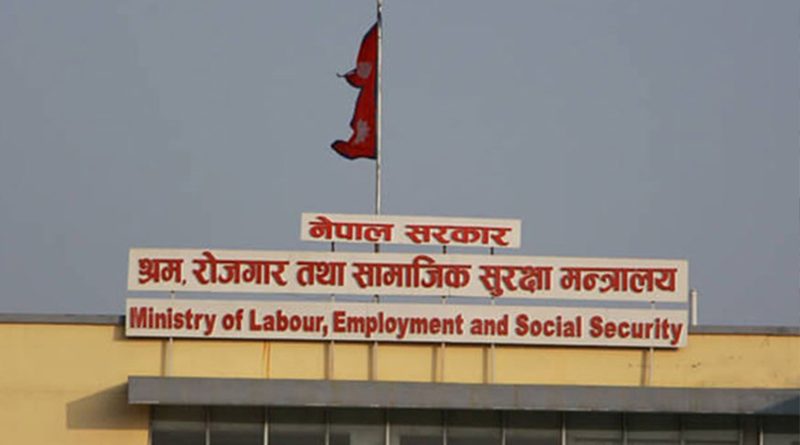
Government preparing to grant legal recognition to domestic workers
Kathmandu – For the first time, the Government of Nepal has initiated the process of granting legal recognition to domestic workers as formal laborers. The Ministry of Labour, Employment, and Social Security has started the necessary legal amendment process under the direction of Minister Sharatsingh Bhandari.
Minister Bhandari emphasized the urgent need to bring domestic workers, who have long remained in the informal sector, into the formal labor system. He stated that the process to establish the legal framework for this has now begun. According to the Ministry, this process is being carried out in line with International Labour Organization (ILO) Convention 189.
As Nepal is a party to this convention, legal provisions are being drafted to formally recognize domestic workers. Although Nepal’s Labour Act 2074 (2017) includes mentions of household workers, the Ministry has noted the need for timely revisions and is working to clearly define and legally include domestic workers in the amended Act.
Since “household workers” and “domestic workers” are different in nature, the law will be revised to clarify and distinguish between the two. In this context, the International Labour Organization (ILO) has appointed a consultant to conduct a gap analysis between Convention 189 and the Labour Act 2074.
The appointed consultant will carry out a detailed study and submit a report to the Ministry. Based on this report, the government will move forward to present ILO Convention 189 for ratification in Parliament. Once ratified, domestic workers will be formally included under the Labour Act.
In Nepal, there has long been confusion in defining the terms “household worker” and “domestic worker.” Some worker groups have been demanding clearer inclusion under the Labour Act, and the government has initiated this process in response.
According to the Ministry, domestic workers are defined as individuals appointed by a company but who provide services while residing in a private home. Once included under the Labour Act, these workers will be entitled to minimum wages, benefits, and other social security protections.
The ILO Convention 189 is considered a historic document for ensuring labor rights of domestic workers. Its implementation is expected to provide dignity, protection, and social justice to millions of domestic workers—especially women.
The government’s step is seen as a move toward delivering justice to those who have worked in the informal sector for years without legal protection.